
Table of Contents
What is Açaí?
Açaí is one of the most emblematic expressions of Brazilian food culture, with origins deeply connected to Amazonian populations and the social dynamics of the Northern region. Extracted from the fruit of the Euterpe oleracea palm tree, native to the fertile floodplains along the banks of Amazonian rivers, it has been part of everyday diets for centuries, long before gaining national and international popularity. Indigenous peoples already used açaí as an energy base in their diet, consuming it with cassava flour, fish, and other local foods. Over time, the fruit became incorporated into both riverside and urban diets in the Amazon, establishing itself as a central element of the regional economy and cultural identity.
Historically, açaí has always been closer to a meal than to a dessert. In Northern Brazil, it is traditionally consumed in a dense form, lightly sweetened, and served alongside savory dishes, especially fried fish and cassava flour. This mode of consumption reflects its original function as an energy-rich and nutritious food, capable of sustaining long hours of physical labor in both riverside and urban communities.
Nutritional benefits
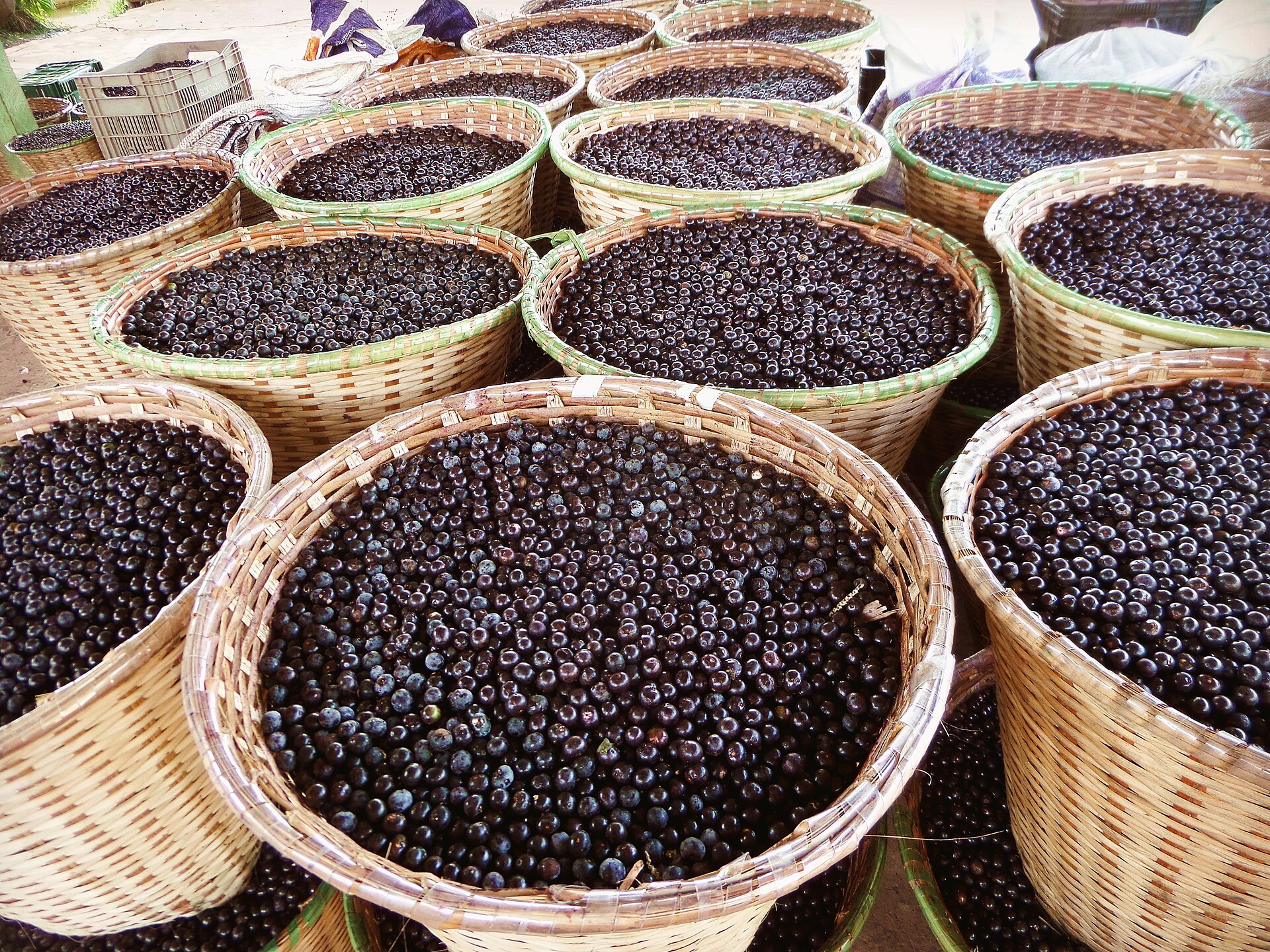
Baskets filled with açaí in the port of Igarapé.
From a nutritional standpoint, açaí is an energy-dense fruit with a composition that differs from most others. While many fruits are rich in carbohydrates, açaí stands out for its higher fat content, particularly monounsaturated fatty acids such as oleic acid—the same found in olive oil—as well as polyunsaturated fats. These are considered high-quality fats and help regulate cholesterol levels, contributing to heart health.
Açaí also contains dietary fiber, which supports healthy digestion, increases satiety, and helps regulate blood sugar levels, especially when consumed in its more natural form, without added sugar. In addition, it provides small amounts of protein and relatively low levels of natural carbohydrates, allowing energy to be released more gradually in the body—one of the reasons it has long been an important food in traditional Amazonian diets.
Another key aspect is the presence of antioxidant compounds, particularly anthocyanins, which are responsible for the fruit’s deep purple color. These compounds help combat free radicals, reducing oxidative stress in the body, which is associated with disease prevention and proper cellular function. Vitamin E, also present in the fruit, reinforces this antioxidant effect.
In terms of minerals, açaí contains potassium, which supports muscle function and overall balance in the body; calcium, essential for bone health; and iron, although in moderate amounts and with variable absorption. It also provides small quantities of B-complex vitamins, which are involved in various bodily functions. Overall, açaí is a complete and nutritious food, combining energy, high-quality fats, and antioxidant properties. When consumed in a balanced way and in its most natural form, it can be a valuable ally for health and everyday nutrition.
Social Relevance
Beyond its nutritional value, açaí holds significant social and economic importance. In the Amazon region, its production chain involves extractivists, riverside communities, small-scale producers, and urban merchants. The harvest, which takes place mainly between July and December, mobilizes thousands of families and constitutes one of the primary sources of income in several areas of Pará and Amapá. In Amazonian cities, “açaí beating houses” , local processing spots, are part of the urban landscape and function as community gathering points, reinforcing the cultural dimension of the food.
Beyond the pulp, açaí seeds also play a relevant role in various fields, further expanding the use of the fruit. In the field of handicrafts, they are widely used to produce jewelry such as necklaces, bracelets, earrings, and religious items. These seeds undergo cleaning, polishing, and dyeing processes that enhance their natural appearance. Such productions generate income for local artisans and highlight a regional and cultural practice within the context of fashion.
In agriculture, after proper preparation, the seeds are germinated in organic substrates kept in shaded and humid environments, giving rise to açaí seedlings. In terms of sustainability, the seeds are also being repurposed to produce “biochar,” a type of charcoal used as a biofertilizer. This process not only presents potential for generating carbon credits but also contributes to more responsible environmental practices. Finally, recent research suggests that extracts obtained from the seeds may have applications in the health field, with studies indicating possible benefits in supporting the treatment of anxiety, although these uses still require further scientific investigation to ensure safety and effectiveness on a larger scale.

A farmer climbs an açaí tree to harvest the pulp and extract it into cellulose.

Japamala with açaí seeds and 108 beads.
Regional Differences and Forms of Consumption

Acai-Bowl mit frittiertem Fisch in Belém, Pará.
With its expansion to other regions of the country, açaí has undergone transformations and gained new forms of consumption. In the North, especially in Pará and Amapá, açaí continues to be consumed in its traditional way: pure, thicker, lightly sweetened, and served with cassava flour, tapioca flour, fried fish, dried shrimp, or cured meat (charque). In many households, it replaces rice and serves as the base of the main meal of the day.
In the Northeast, açaí became popular through sweeter and creamier adaptations. It is commonly blended with sugar, guaraná syrup, and served with tropical fruits, granola, and powdered milk. In this region, it takes on a character closer to a dessert or a refreshing snack, suited to the warm climate and local food culture.
Southeast and Center-West

In Southeastern Brazil, especially in large cities, açaí has established itself as a food associated with urban lifestyles and sports practices. Bowls topped with banana, strawberry, granola, honey, peanut butter, and other energy-boosting ingredients have become common. The texture is usually creamier and sweeter, often served frozen, turning it into a kind of nutritious sorbet. This is the version that has spread most widely both nationally and internationally.
In Southern Brazil, consumption follows a pattern similar to the Southeast, but with a stronger presence in cafés, juice bars, and establishments focused on healthy eating. Combinations with fruits, chocolate, nuts, and yogurt are common, and açaí appears mainly as an energy snack.
In the Central-West region, consumption blends influences from the North and Southeast. In some cities, it is still possible to find denser and less sweet versions, while in urban areas bowls with a variety of toppings predominate. The geographical proximity to the Amazon also facilitates access to less processed pulp.
These different forms of consumption show how açaí has transformed as it spread across the country, maintaining its Amazonian identity while adapting to new eating habits. From a traditional food of riverside populations to a symbol of contemporary nutrition, açaí encapsulates Brazil’s cultural diversity and demonstrates how a regional delicacy can acquire multiple meanings without losing its roots.
Ordering an Açaí?
Ordering an açaí in Brazil can be simple, refreshing, and enjoyable—perfect for savoring and sharing good moments. It all comes down to knowing what you want to experience on your palate. After understanding the regional differences, the key is to tailor your order to your taste. In the North, expect a purer, denser, and less sweet açaí, often served without sugar and even paired with savory dishes. In the Southeast and much of the country, the more common version is blended with guaraná syrup—creamier, sweeter, and often loaded with toppings. If you’re looking for something refreshing, go for lighter combinations; if you want energy and intensity, don’t hold back on the add-ons. In the end, that’s what açaí is: a versatile experience that adapts to the moment and to your body. Knowing how to order is just the final step to enjoying everything it has to offer.





Leave A Comment